
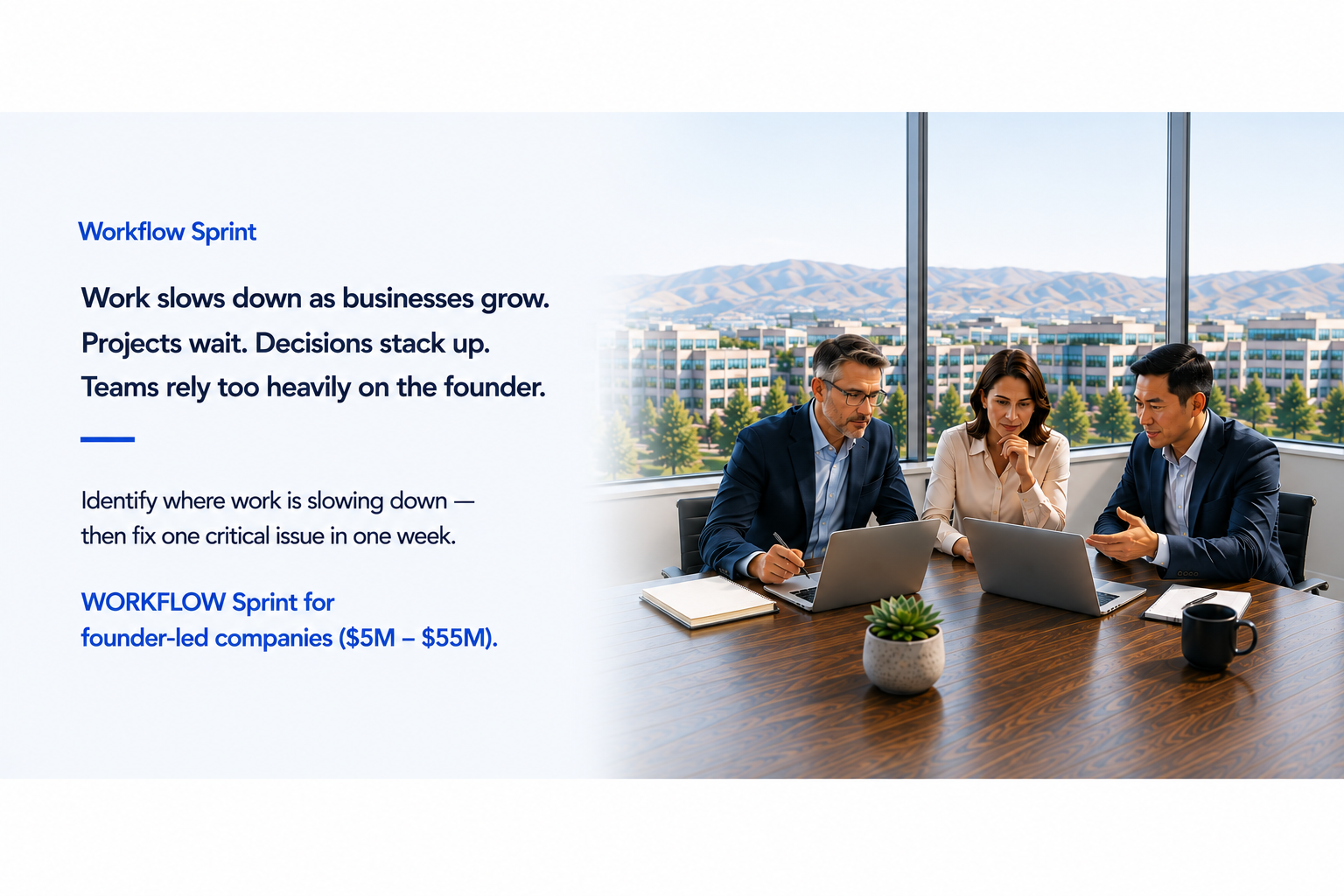
Built for founders whose companies have outgrown founder-led decision making
Trusted by founder-led companies navigating growth complexity
25+ years advising senior leaders
Fortune 500 experience across North & South America
Proven results in complex, high-friction organizations
Key outcomes from client work:
Reduced daily incoming calls by 160,000 (35% decrease) in a telecommunications division of 8,500 employees
Helped an engineering consulting firm increase billing by 40% year-over-year
Improved decision flow, reduced bottlenecks, and accelerated execution across multiple large-scale organizations
Experience includes work with organizations such as Bell Atlantic (Verison), Procter & Gamble, and Pacific Gas & Electric.
Eroca Lowe works with leaders inside complex organizations to improve how decisions move and how work gets done. Her approach focuses on clarifying decision flow, reducing operational friction, and enabling faster execution—without adding unnecessary complexity.
Today, she brings the same principles to founder-led companies facing growth-related bottlenecks.
You May Be Feeling This
Your team is capable, but too many decisions still depend on you
Projects move forward only after repeated follow-up
Work slows down between departments or handoffs
Meetings create more coordination instead of more momentum
The business has grown, but execution still feels fragile
You’re spending too much time clarifying, checking, and unblocking work
Teams are busy, but important work still stalls
What is a Workflow Bottleneck Sprint (and how it works)?
A one-week sprint to identify workflow bottlenecks and improve execution speed with a clear, implementable fix.
It is designed for founder-led companies where:
• Decisions are bottlenecked at the founder or leadership level
• Work moves slowly between teams
• Projects stall due to unclear ownership or repeated clarification
• Execution becomes harder as the company scales
During the sprint:
• One workflow is selected
• The flow of work is mapped and analyzed
• The bottleneck is identified
• A practical fix is designed
• A clear implementation plan is delivered
The goal is not to redesign the entire business.
The goal is to remove one high-impact constraint so execution can move faster.
Where Work Gets Stuck
A one-week sprint to identify workflow bottlenecks and improve execution speed with a clear, implementable fix.
Projects take longer than expected
Decisions wait on the founder or senior team
Work gets handed back and forth
Teams need repeated clarification
Details fall through the cracks
Execution slows as the business becomes more complex
The issue is usually not effort.
The issue is the workflow.
This is what creates hidden drag inside growing companies.
What the Sprint Does
In one week, we focus on one specific point where work is slowing.
We:
Identify the core workflow bottleneck
Map the workflow and decision flow behind it
Diagnose where the breakdown is happening
Design a practical fix
Walk you through exactly how to implement it
Identify where AI or automation may improve the workflow, if relevant
The goal is not to analyze the whole business.
The goal is to fix one high-value point of friction.
What You Get
By the end of the week, you have:
A clear map of the workflow
Identification of the bottleneck or breakdown
A step-by-step implementation plan
A working session to walk through the fix
Recommendations for tools, AI, or automation where relevant
Clear next steps your team can act on immediately
This is not just a report.
You leave with a usable fix and a clear understanding of how to put it into practice.
This is designed to be high-impact, improving execution speed with minimal time required from your team.
1. Initial Session
90–120 minutes
We meet with the founder, owner, or key leader to understand where work is slowing and select one workflow to examine.
We map the workflow and analyze where the breakdown is happening, including delays, unclear decisions, weak handoffs, duplicated effort, or missing information.
(No time required from your team during this phase)
2. Workflow Mapping + Analysis
Completed behind the scenes during the week
3. Working Session
60–90 minutes
4. Final Delivery
We walk through the workflow, the bottleneck, and the recommended fix.
You leave knowing what needs to change, what to do first, and how the fix can be implemented.
We fix one place where work is getting stuck—and make it function reliably.
You receive a clear implementation plan outlining:
The workflow problem
The recommended fix
The steps to implement it
Who needs to be involved
What can be done immediately
The Outcome
After the sprint, your team has a clearer way to move work forward.
The intended result is:
Fewer delays and handoffs
Faster decisions
Clear ownership of next steps
Less back-and-forth between teams
Who This Is For
Who This Is NOT For
This is for founder-led companies where growth has created more complexity than the current workflow can easily handle.
It is especially useful if:
The founder is still too involved in day-to-day decisions, creating founder dependency
Teams are capable but not fully aligned
Projects are delayed by handoffs, approvals, or unclear ownership
The company has added tools, but the workflow still feels messy
Leadership wants practical improvement without a major overhaul
This is not a fit if:
• You’re looking for a full business transformation immediately
• You’re primarily looking for tools, software, or AI solutions
• You’re not directly involved in how decisions are made
• There is no clear workflow problem to focus on
• You’re not ready to act on a practical fix within your team
Where AI Fits
AI is not the starting point. The workflow is.
The business problem comes first.
Where AI can meaningfully improve the workflow, we identify it and show how it may help.
That may include reducing operational friction, improving decision flow, reducing manual work, and improving handoffs...
AI is used only where it supports the fix.
What Happens After the Sprint
Some companies stop after the sprint because the immediate issue has been clarified.
Others continue into advisory work.
Advisory may include expanding the work across additional workflows, supporting implementation, bringing in team workshops, working with additional departments, or coordinating with specialists where technical implementation is needed.
The sprint is the entry point.
Advisory is the deeper work to further improve execution speed across workflows.
Example WorkSprint
A founder-led services company was experiencing delays because proposals required repeated review and approval from the founder.
In one sprint, we mapped the proposal workflow, identified where decisions were getting stuck, and restructured how approvals moved across the team.
Result:
- Proposal turnaround reduced significantly
- Fewer back-and-forth revisions
- Clear ownership across the team
Frequently Asked Questions
-
A workflow bottleneck is a point where work consistently slows down or gets stuck, delaying execution across the team. It often shows up as repeated approvals, unclear ownership, or decisions waiting on leadership. These bottlenecks create operational friction and reduce execution speed as a company grows.
-
This sprint is designed for founder-led companies where execution is slowing due to workflow bottlenecks, unclear decision flow, or founder dependency. It’s especially useful when teams are capable, but work is getting stuck between people or stages.
-
We identify a single high-impact workflow bottleneck, map the workflow and decision flow behind it, and diagnose where execution is breaking down. Then we design a practical fix and walk you through exactly how to implement it.
-
The sprint runs over one week, with two working sessions and independent workflow analysis in between. Most of the work happens behind the scenes, minimizing time required from your team while still improving execution speed.
-
AI is used only where it improves the workflow. That may include reducing operational friction, improving decision flow, or automating repetitive steps. The business problem comes first—AI supports the fix, not the other way around.
-
AI is introduced only where it supports the workflow after the underlying bottleneck is understood.
It is not the starting point. Workflow structure comes first.
-
Some teams implement the fix and move forward immediately. Others continue into advisory work to improve additional workflow bottlenecks and further increase execution speed across the organization.
-
Traditional consulting often analyzes broad processes over long timelines. This sprint focuses on one specific workflow bottleneck and delivers a practical fix within a week, with clear steps your team can implement immediately.
-
We design the fix and walk you through implementation in detail. If needed, we can support execution afterward, but the goal is to give your team a clear, actionable plan that improves workflow and decision flow right away.
What this is not
Not a long consulting engagement
Not a theoretical analysis
Not a full business redesign
About
Accelerated Outcomes works with founder-led companies to improve decision flow, remove workflow bottlenecks, and reduce founder dependency through decision architecture.
What Happens on the 30-Minute Call
This is a focused working conversation—not a sales call.
We will:
• Identify where work may be slowing inside your business
• Clarify whether there is a clear workflow bottleneck to address
• Determine if a sprint is the right next step
If there’s a clear fit, we’ll outline how the sprint would work.
If not, you’ll leave with a clearer understanding of where to focus.
Fix One Workflow
If there’s a workflow currently slowing your team, this is the fastest way to address it.
Begin with one workflow.
Find the bottleneck.
Fix the workflow bottleneck that is slowing execution speed.
We’ll identify where work is slowing and whether a sprint makes sense.